A box score lands seconds after the final whistle. A few minutes later, a tidy recap appears online with the winner, leading scorer, turning point, and a polished final sentence. Was a reporter typing at remarkable speed, or did software write the story?
AI content detectors can help answer that question, but they cannot provide a definitive verdict.
Sports journalism is an awkward test case because automated match coverage existed long before ChatGPT, while human-written recaps often use predictable structures.
A detector score works best as a reason to look closer, alongside bylines, disclosures, source checks, editing records, and the publisher’s AI policy.
Readers and editors now routinely ask a question that barely existed a decade ago: who, or what, wrote the article?
Contents
Sports bots were writing recaps years before ChatGPT

Sports became an early testing ground for automated journalism because games produce structured data. Scores, lineups, shooting percentages, lap times, and standings can be processed quickly by software.
The Washington Post used Heliograf during the 2016 Rio Olympics to publish automated updates involving schedules, results, and medal information. Academic research on Olympic automation found that editors still shaped what the bot covered, even when data drove the output.
Early systems usually relied on templates and rules. Generative AI expanded the possibilities by producing smoother prose and greater variation.
ESPN provided a visible example in 2024 when it announced AI-generated recaps for National Women’s Soccer League and Premier Lacrosse League matches.
A Front Office Sports report said every recap would receive human review and carry an “ESPN Generative AI Services” byline. The rollout also drew criticism after an announcement graphic included an incorrect match date and team record.
What does an AI content detector actually detect?

An AI detector looks for statistical and stylistic signals associated with machine-generated writing. Depending on the product, signals may include word predictability, sentence patterns, token probabilities, or features learned from collections of human and AI text.
The output is usually a score, probability, classification, or highlighted passage. For example, ZeroGPT’s AI text detector analyzes submitted text and estimates whether its linguistic patterns are more consistent with human or AI-generated writing.
Chicago Booth research tested about 2,000 human-written passages and AI-generated counterparts across several writing formats. Commercial systems including Pangram, Originality.ai, and GPTZero performed well on medium and long passages under the study conditions, while very short passages were harder to classify.
Reported false-positive rates for the three commercial tools stayed below 1%, although results changed with text length, language model, and decision threshold.
Research published through the Association for Computational Linguistics adds an important warning. An ACL detection benchmark found that performance can fall when detectors encounter unfamiliar domains or unseen generators. Separate mixed-authorship research found that human writing revised by a model, or AI text heavily edited by a person, remains especially difficult to classify.
Sports copy creates a natural edge case. A short match recap packed with standard verbs, scores, and names may be entirely human while still looking statistically predictable.
Why detector scores are entering sports newsrooms
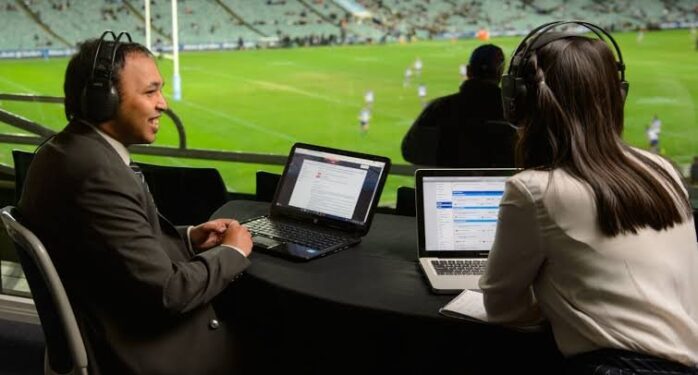
Editors have practical reasons to scan copy, especially when large volumes of freelance, syndicated, affiliate, or commerce content pass through a publishing system.
A detector can act as an early warning. A high score may prompt an editor to inspect draft history, ask how reporting was conducted, verify quotations, or check whether a contractor followed an AI disclosure rule. Publishers can also use detectors to audit large batches of copy.
The safer newsroom use is triage. Treating “92% AI” as a final finding can create a false accusation, particularly when the article is short, formulaic, or heavily edited.
Hybrid authorship makes binary labels less useful. A reporter might conduct interviews, write a first draft, use AI for grammar suggestions, rewrite several paragraphs, and send the result to a human editor. A simple human-or-bot label misses much of that workflow.
Sports Illustrated showed why provenance matters

A major AI-era sports media controversy involved Sports Illustrated in 2023. Futurism reported that product-review content appeared under author profiles it said were fabricated and paired with AI-generated headshots.
Arena Group, the publisher at the time, denied that the articles themselves were AI-written and said a third-party vendor had used pseudonyms. Sports Illustrated removed the material and ended the vendor relationship, according to CBS News coverage.
The episode exposed a problem that linguistic detection alone cannot solve. Readers also wanted to know whether the bylines represented real people, who produced the copy, what editorial checks occurred, and who accepted responsibility for publication.
Authorship is partly a provenance question. A detector examines prose. Journalism also relies on records showing where reporting came from and who stands behind the finished article.
|
Signal |
What it can tell you |
Main limitation |
|
AI detector score |
Whether language resembles known AI output |
Probability can be wrong |
|
Byline and AI disclosure |
Who claims responsibility |
Depends on publisher honesty |
|
Draft history |
How a story developed |
Readers rarely have access |
|
Source and quote checks |
Whether reporting can be verified |
Says less about authorship |
|
Human editor review |
Whether editorial judgment occurred | Quality varies |
Newsroom policy may matter more than the score

In July 2026, the Associated Press released updated newsroom standards permitting uses such as early research, transcription, translation, headline suggestions, grammar, spelling, and search optimization.
AP also said AI output must be reviewed and edited by journalists before publication, while sourcing, verification, reporting, and editorial judgment remain human responsibilities.
A 2026 Journal of Media Ethics study examined AI guidance from 14 U.S. news organizations. Researchers found recurring values including transparency, fairness, and accountability, while arguing that many policies remained too vague for consistent risk management.
For a sports desk, a workable policy can stay simple: define permitted AI tasks, require disclosure when AI materially shapes published copy, preserve human review, and create a process for investigating detector flags. Vendor content should follow the same rules as staff work.
Readers can use a lighter version. Check for a named reporter or AI label. Look for original quotes and scene-specific detail. Compare unusual claims with league, team, or governing-body records. Treat a detector score as one clue rather than the entire case.
The future sports article may have several authors
A future match story may begin with official live data, receive an automated first draft, gain a reporter’s locker-room quotes, pass through an AI copy-editing tool, and finish under a human editor.
AI detectors are reshaping sports journalism because they push publishers to document authorship and editorial responsibility more carefully. Their value is greatest when they trigger verification rather than replace it.
Sports has always loved a scoreboard. Authorship, unfortunately for anyone hoping for one neat number, increasingly needs context.